E-commerce platform
WooCommerce: flexible e-commerce on WordPress
WooCommerce is e-commerce built on WordPress, with open source code. You own the store, you pay no commission on what you sell, and the platform is already built for AI agents to find and buy your products.
6 in 10websites with a content management system run WordPress (W3Techs).
7 million+active WooCommerce installations (WordPress.org).
£0in commission per order to the platform.
The platform
The most widely used web platform, with e-commerce built in
WooCommerce turns a WordPress site into a store. Products, checkout, orders and customers live in the same system as the rest of the site, so guides, landing pages and product pages share the same editors, the same SEO and the same code.
You own the platform
Open source under the GPL. No vendor can raise the licence fee or shut your store down. WordPress pros and cons.
No commission
You pay for hosting, extensions and development. Never a share of what you sell. See the comparison.
Products of every kind
Simple and variable products, attributes, stock and sale prices come as standard. Woo’s product documentation.
Payments for every market
Woo’s marketplace has payment gateways for cards, invoices, instalments and wallets. How to choose the right one.
Shipping and tax as standard
Tax settings and shipping zones are included, and carriers plug in with shipping and delivery extensions.
Extend it with extensions and APIs
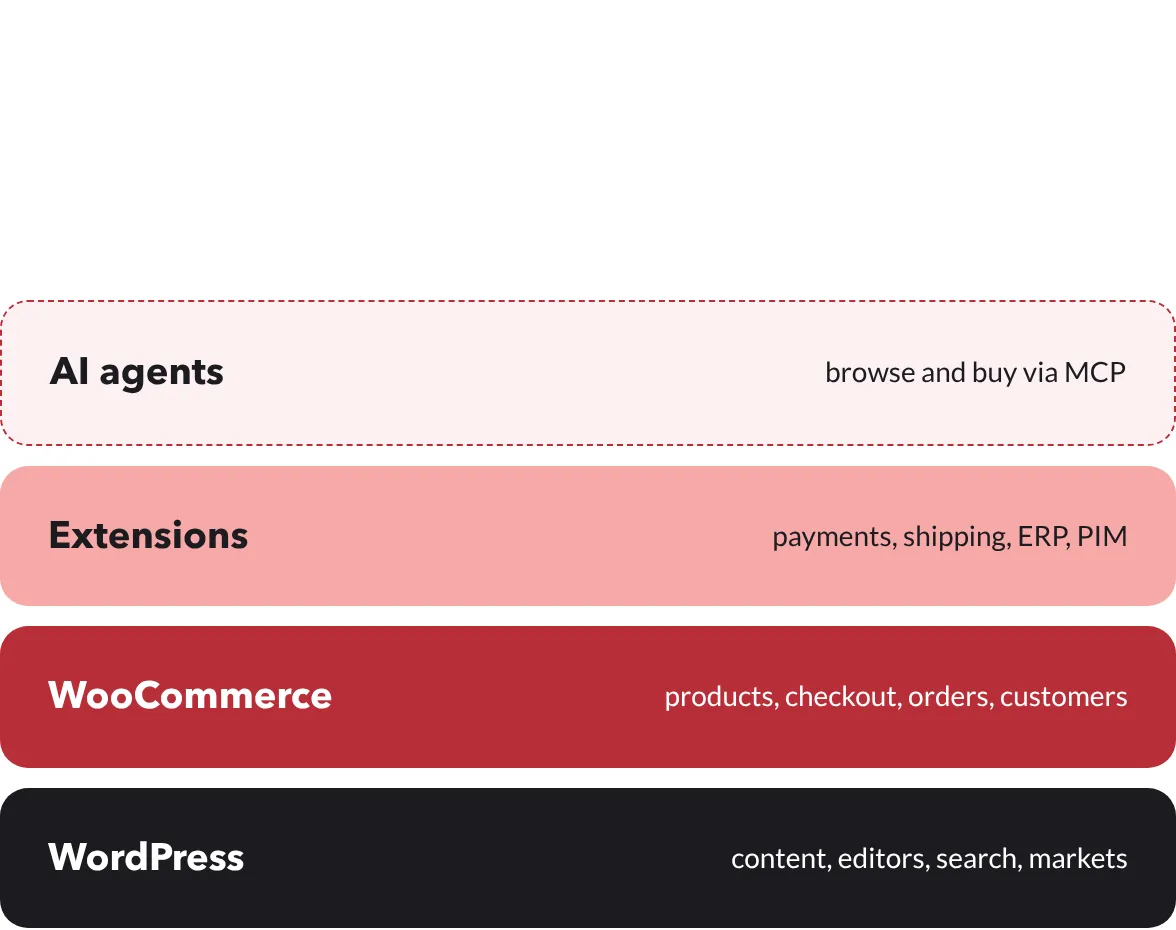
Subscriptions, bookings and B2B pricing can be added. Marketing automation and everything else connects through the REST API and MCP.
WordPress as the foundation
WordPress: the foundation under the store
WordPress is run by an open community and the WordPress Foundation, not by a single company. Thousands of developers, agencies and suppliers know the platform, and nobody can lock you in. That is also why large organisations choose WordPress.
- Content that sells. The block editor lets you build landing pages, guides and campaigns without a developer, and products can appear in any piece of content. Read how to make a landing page that converts and Gutenberg vs Elementor.
- Visible in search and AI services. Full control over URLs, headings, structured data and sitemaps.
- Multiple markets. With multisite and MultilingualPress, every market gets its own site, language and currency on shared code. How to take a WooCommerce store international.
- Many editors. Roles and permissions for anything from a single editor to a full marketing team.
- Security and data protection. WordPress has its own security team and an open process for updates. GDPR for WordPress and WooCommerce.
For developersPHP, MySQL, the REST API, React blocks and the WordPress Abilities API for AI agents. No proprietary template engine to learn, and every line of code can be read, reviewed and changed. More about WordPress.
woocommerce.com
How WooCommerce and woocommerce.com work
WooCommerce is developed by Automattic and is free to download. The core is open source, and that core is the platform. Automattic makes money from the extensions on woocommerce.com and from the WooPayments payment gateway, not from your sales.
woocommerce.com lists more than 1,000 extensions. They are sold with an annual licence that covers updates and support. We have our own extension there, for price history under EU rules. New to the platform? Start with our introduction to WooCommerce.
| What you pay for | How it works |
|---|---|
| WooCommerce | Free. Open source. |
| Extensions | Annual licence per extension from woocommerce.com, or your own code. |
| Payment gateway | Your choice. WooPayments has no monthly fee, only a fee per transaction. Other providers work just as well. |
| Hosting and support | You choose the provider. Read how we approach hosting and support. |
| Development | Whatever makes your store unique. |
| Commission | None. |
Choose a partner Woo has vetted
A store that has to carry a business is not built by whoever is cheapest per hour. Woo vets the agencies in its own directory, Woo Agency Partners. You will find us there too.
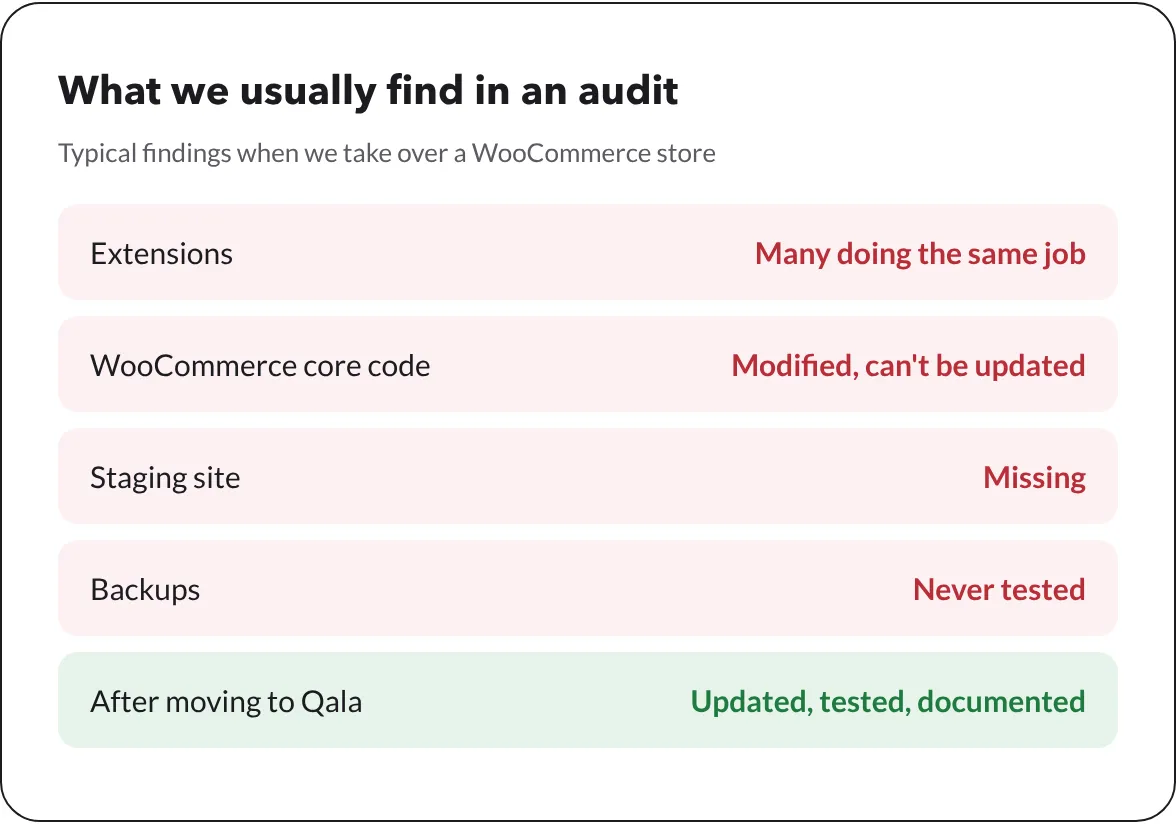
The most common thing we see when we take over a store is that it was built quickly and cheaply, and every update since has turned into a project.
- Agency, freelancer or in-house? What you get and what you risk.
- Vibe or hire? Find out whether your store can be built with AI and freelancers, or needs a team.
- Guide to setting requirements for WordPress and WooCommerce projects.
- Woo’s 15 questions to ask an agency before you choose.
- Our profile on Woo
Cost
No commission to the platform
On a SaaS platform, costs grow with your sales. With WooCommerce you pay for what you build and run, and the margin stays with you.
| WooCommerce | SaaS, for example Shopify Plus | |
|---|---|---|
| Licence | £0 | From $2,300 a month |
| Share of revenue | 0% | Can apply as sales grow |
| Your own payment gateway | Your choice, no extra fee | Extra fee per transaction unless you use the platform’s own |
| Extensions and apps | Annual licence or your own code | Monthly subscription per app |
| Code and data | Yours | On the vendor’s platform |
Shopify Plus according to shopify.com. Prices in US dollars.
Compare WooCommerce with the alternatives





Thinking of switching? How to move your e-commerce to WooCommerce.
Agentic commerce
Built for agentic commerce
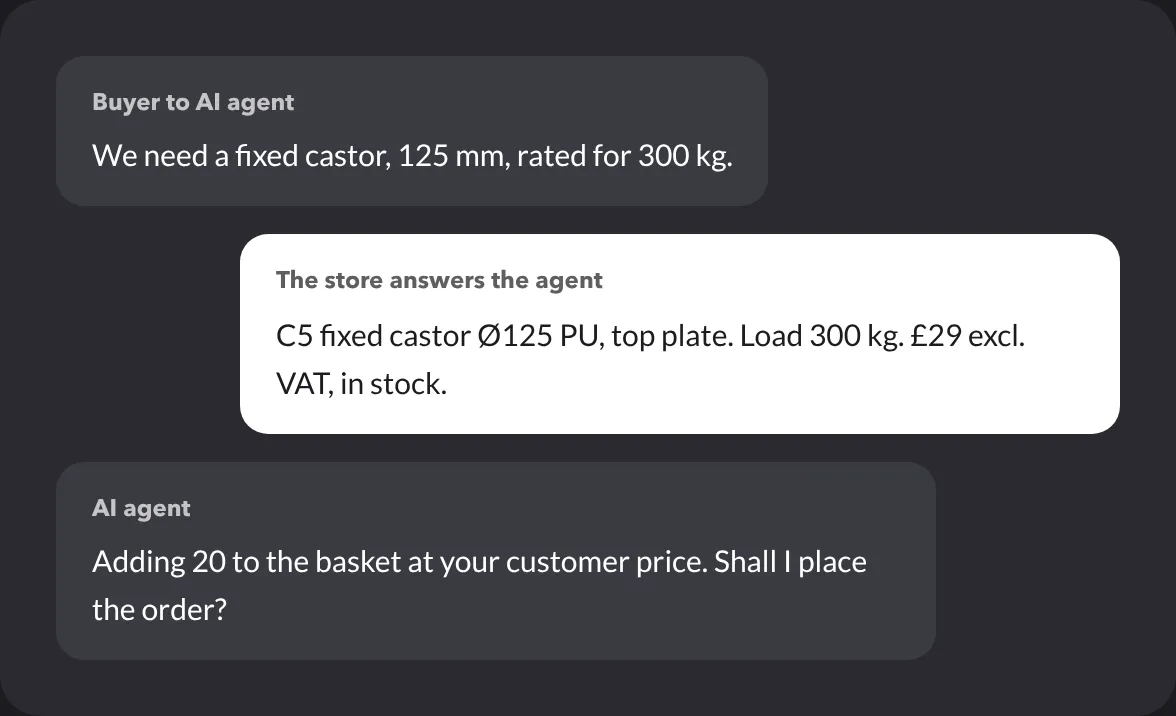
AI agents are starting to shop on behalf of customers. They search, compare and place orders. That means your store has to answer the agent directly, not just show a web page.
- MCP in WooCommerce. WooCommerce has its own MCP interface built on the WordPress Abilities API, still labelled as a developer preview. Agents can read and manage products and orders with the same permissions as a logged-in user.
- Buying directly in AI services. Woo is working with Stripe on the Agentic Commerce Protocol, the standard for purchases inside AI services.
- You decide. With open source, you don’t wait for a vendor to decide which AI services you can appear in.
- We run it ourselves. angrycreative.com is connected to AI agents with the same technology. How we use AI.
Where the platform needs help
Where WooCommerce needs help
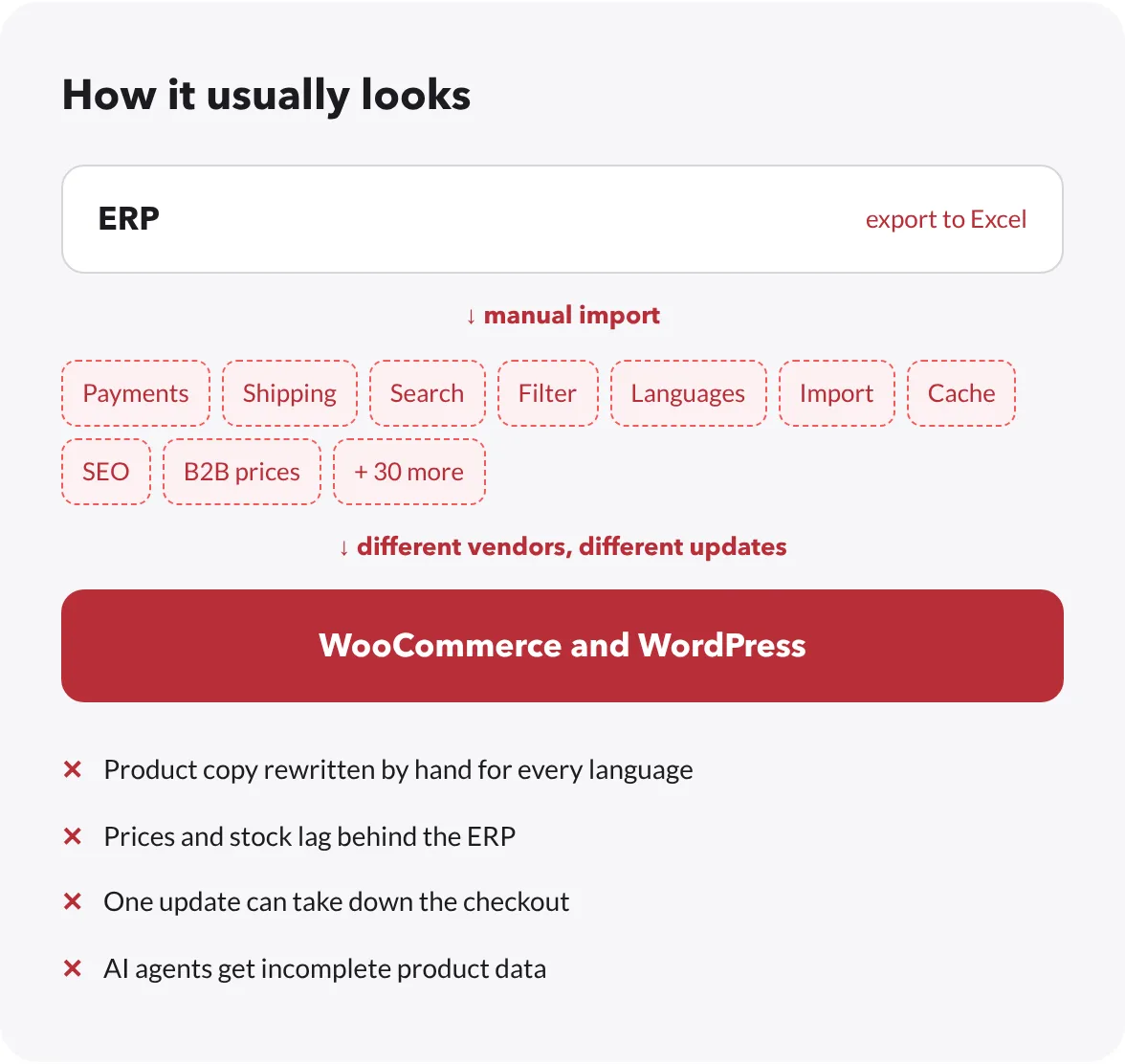
WooCommerce is built to suit as many stores as possible. You notice it when the catalogue grows or the business gets more complex.
- Search. The default search looks for words in the database without ranking the results. With thousands of products it gets slow, and the wrong things come first.
- Filters. Filters on size, material and load capacity get heavy when every product has many attributes and variations.
- B2B pricing. Customer-specific prices, invoice payment and quotes are not included as standard.
- Product data. Many products and languages get heavy to maintain directly in WooCommerce.
- Multiple markets. The wrong architecture from the start is expensive to rebuild.
- Clashing extensions. Every extension is built on its own. Forty extensions from different sources are forty things that can break at the next update.
Qala
Qala: our packaging of WooCommerce
Qala is not a platform of its own. It is WooCommerce and WordPress, packaged by us. Everything we have learnt since 2007 is gathered there: the architecture, the blocks, the extensions we trust and the integrations with the systems around the store.
You get the freedom of open source and the security of a finished product. Your store is built in a way we know holds up, and every improvement we make to Qala benefits every customer. Qala and everything we deliver to you is licensed under the GPL, so the code is yours.
Qala comes in three tiers, Light, Standard and Premium, depending on how far your e-commerce has come. See what Qala E-commerce includes.
Where PIM fits in
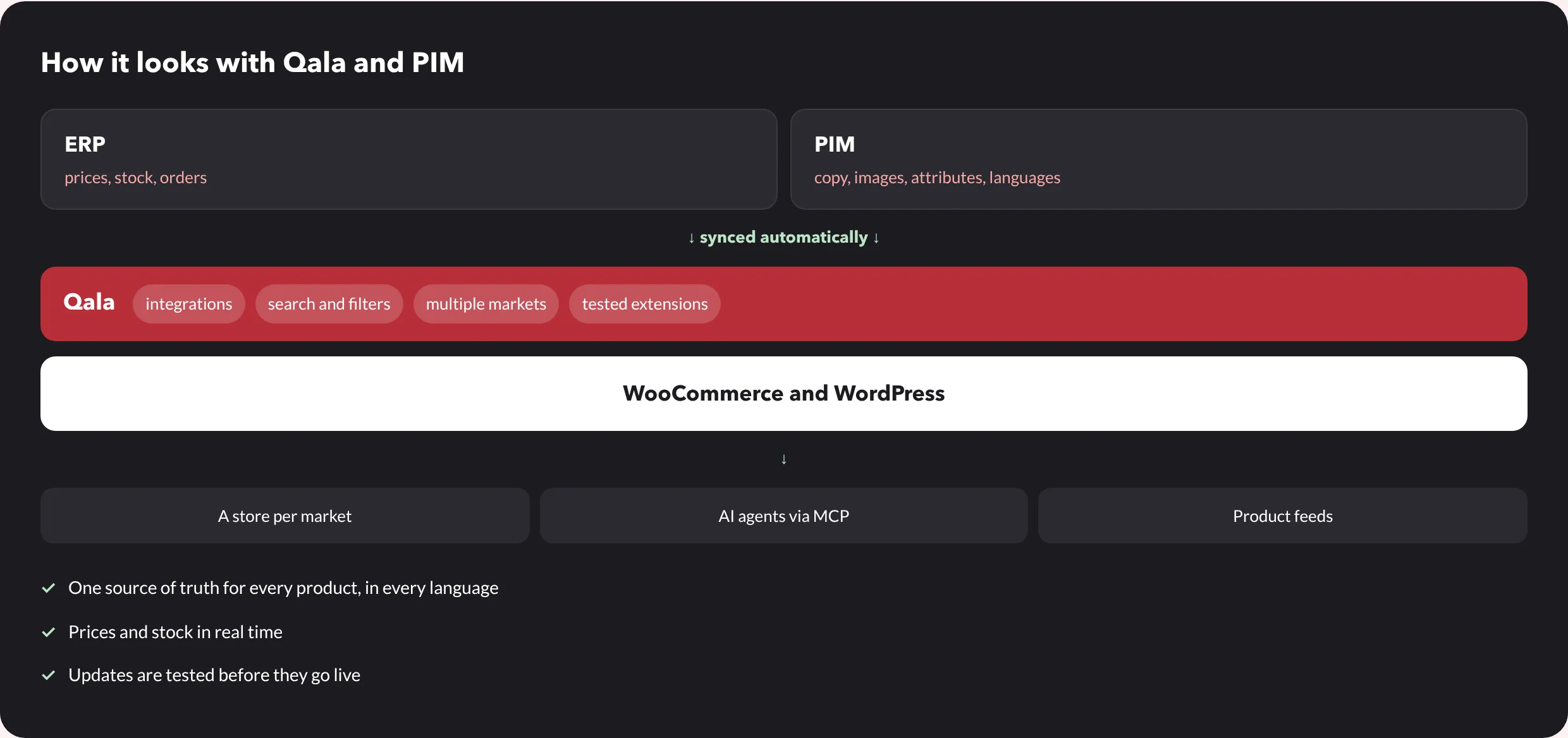
WordPress and WooCommerce display and sell. When you have many products, languages or channels, product data needs a home of its own. A PIM owns copy, images and attributes, the ERP owns prices, stock and orders, and the store pulls from both.
We build PIM with Pimcore or OpenDXP, the open version with no licence fee.
How we have solved the weaknesses
| Where WooCommerce needs help | How Qala solves it |
|---|---|
| Search and filters | Elasticsearch with synonyms and typo tolerance, and filters that handle thousands of products. Qala Elastic. |
| B2B pricing | Customer-specific prices and stock synced from the ERP. |
| Product data | PIM with Pimcore or OpenDXP, connected to the store. |
| Multiple markets | Qala Multimarket with multisite, MultilingualPress and a shared basket. |
| Clashing extensions | A tested selection, updates on staging first and support and hosting with us, with a 24/7 on-call team. |
Integrations already in Qala
ERP, PIM, payments and shipping. We maintain them for every customer, so you don’t pay for us to learn. 46 things you don’t have to solve from scratch with Qala.






Take over or build new
Buy it ready-made, not by the hour
When we take over a store, we start with an audit. The platform is rarely the problem. How the store was built usually is.
- Built right from the start. With Qala you start on a foundation that already holds up, instead of paying for the same foundation in every project.
- The only agency in Sweden accredited for both WordPress and WooCommerce.
- An average of 10 years with WooCommerce per developer, and senior developers only.
- The code is yours. Qala and everything we deliver to you is licensed under the GPL. If you switch agency, the next one can use all of it.
Is it right for you?
Is this right for you?
We build for businesses that see e-commerce as an investment. If you are starting with no budget, there is a better way to begin.
Your store is business-critical
Build it right from the start with Qala
You sell in several markets, connect your ERP or have customers with their own prices. Every hour your store is down costs money.
You are starting a smaller store yourselves
Get started on the right foundation
Choose a few well-maintained extensions, test updates on a copy, don’t skimp on hosting and check that your backups can actually be restored. Read the introduction to WooCommerce and three common myths. Once the store is running: grow sales with customer lifecycle marketing.
Cases
How we have done it for others

Global, 21 countries
Polestar
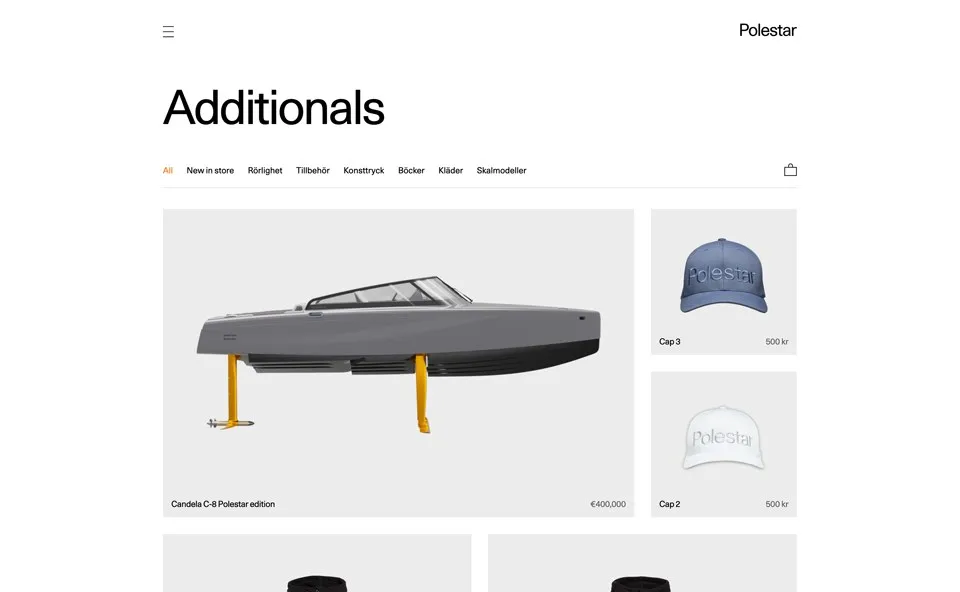
One WooCommerce multisite selling Polestar Additionals in 21 countries. B2C sales grew by 232% from 2024 to 2025.

UK, B2B
Sentric Safety Group
Safety brands brought together in one multisite for the UK, US and France, with a WooCommerce product catalogue, Qala filters and a product configurator.
FAQ
Questions we often get about WooCommerce
Can’t find the answer? Book a call and we’ll go through it with you.
Book now
Want e-commerce that holds up?
Book a first call with Amy Slade. Tell us where your e-commerce is today and where you want to take it, and you’ll get a straight answer on whether WooCommerce is right for you.
- Pick a time in the calendar
- Tell us about your store and what it needs to handle
- Get a straight answer on whether WooCommerce and Qala are right for you
Further reading
More about WooCommerce
The latest from our knowledge hub on WooCommerce.