
Angry Creative vs. Competitors
WordPress vs. Storyblok
Choosing the right CMS affects everything from editorial workflows and development speed to security, costs, and future growth.
Storyblok and WordPress can both be used for modern, API-driven solutions, but they are based on different architectures. The crucial question, therefore, is not whether headless is modern, but whether the added complexity actually creates sufficient business value.
In recent years, many companies have chosen headless architecture to gain greater technical freedom and flexibility. In the right project, this can create significant value. But when the website or e-commerce platform is the primary digital channel, the decoupled model also entails a separate presentation layer that must be developed, deployed, and maintained over time.
Both Storyblok and WordPress can structure content and make it available via APIs. The difference is that Storyblok is built around a separate front-end application, while WordPress also has an integrated presentation layer from the start. Therefore, the comparison largely comes down to what the additional architecture actually delivers in relation to the development cost.
At Angry Creative, we’ve been working with WordPress since 2007 and have seen the platform evolve into a stable foundation for complex and business-critical solutions. We’ve packaged our experience from large-scale projects into Qala, our refined WordPress architecture for organizations with high demands for performance, security, e-commerce, and international scalability.
In this article, we compare Storyblok, WordPress, and Qala and examine the differences in areas such as user-friendliness, architecture, cost, e-commerce, and international growth.
What is Storyblok?
Storyblok is a cloud-based headless CMS where content is modeled as components, blocks, and fields. The content is stored as structured data and made available to other systems via APIs.
At the content model level, there are clear similarities between Storyblok and a WordPress setup using, for example, ACF or custom blocks. In both cases, developers define which content types, fields, and components editors should be able to use.
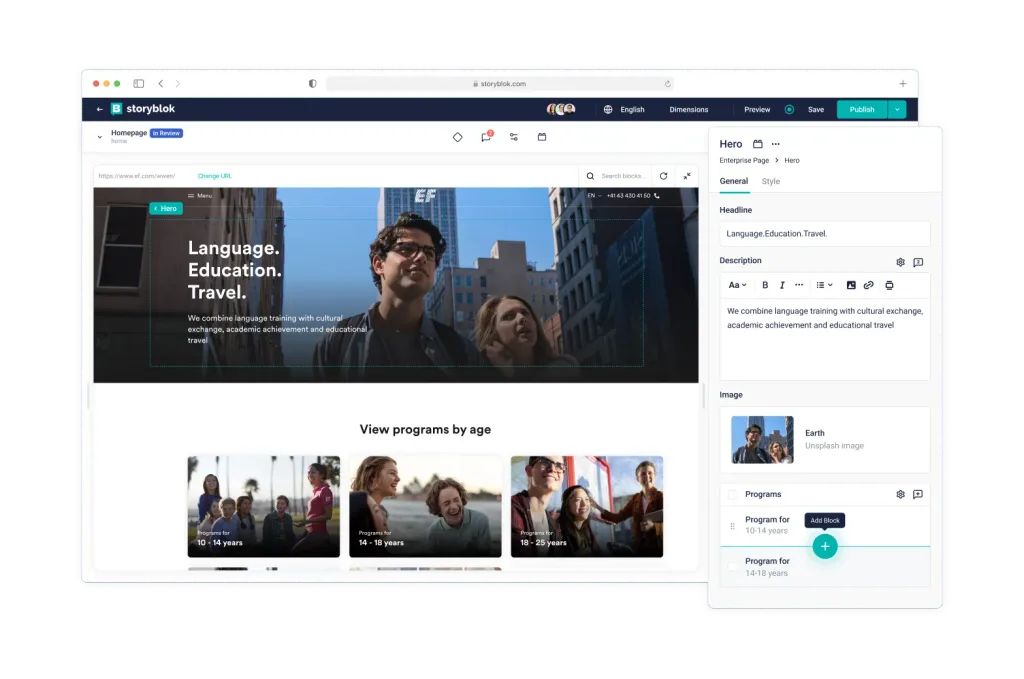
Storyblok offers a visual editor where editors can work with the content and see changes in a live preview of the external front end. However, the extent of editorial freedom users have depends on which components, variations, and layout options the developers have implemented.
The key architectural difference is that Storyblok does not render the public website itself. In order for the content to be displayed, a separate front-end application must be built, for example, in Next.js or Nuxt. That application retrieves the content from Storyblok’s API and converts it into the HTML and user experience that the visitor encounters.
Storyblok is sold as a SaaS service with subscription- and usage-based costs. In addition to the cost of the CMS platform itself, the organization must therefore budget for the development, operation, and ongoing maintenance of the separate front-end application.
What is WordPress?
WordPress is the world’s most widely used CMS and is based on open source code. The platform features both an integrated presentation layer and a built-in REST API.
This means that WordPress can be used in two ways.
It can be used with its integrated presentation layer, where content, editing, and rendering are handled within the same platform. It can also be used in a headless configuration, where WordPress handles only the content and a separate front-end application retrieves the data via APIs.
Using, for example, ACF, custom blocks, and the WordPress REST API, it’s possible to build a headless architecture that in many ways resembles a setup with Storyblok. The main difference is that WordPress doesn’t require the organization to choose that path.
WordPress’s true strength therefore lies in its flexibility. An organization can use the integrated presentation layer and take advantage of Gutenberg, the extensive plugin ecosystem, and the built-in integration between content, functionality, and presentation. If a specific use case calls for a headless approach, that option is also available.
The WordPress core has no license fee. Professional WordPress solutions naturally involve costs for development, hosting, premium plugins, security, and ongoing maintenance. The difference is that a larger portion of the investment can be allocated to features, design, and business value rather than to a CMS license and a separate presentation layer.
What is Qala?
Qala is not a separate CMS. It is Angry Creatives’ refined enterprise architecture built on top of WordPress.
We created Qala because standard WordPress often needs to be enhanced to meet the demands of larger and more complex projects. This applies, for example, to performance, security, component management, international scalability, advanced search, e-commerce, and integrations with external business systems.
Qala uses WordPress’s built-in presentation layer instead of automatically separating the frontend and backend. This means we can reuse a proven and quality-assured architecture instead of starting every project by building a new presentation and integration layer from scratch.
The platform complements WordPress with a curated component library, ready-made templates, quality-assured plugins, and proven solutions for complex web and e-commerce projects.
The goal is not to use less advanced technology. The goal is to avoid advanced technology that does not create commensurate value for the business.
By reducing the amount of custom-built infrastructure, we can devote a larger portion of development time to customer experience, conversion, integrations, and features that actually drive the business forward.

Storyblok vs. WordPress vs. Qala at a Glance
Storyblok
WordPress
Qala
Ease of Use
Storyblok:
Storyblok offers a visual editor with a live preview of the external front end. Content is managed through predefined components and fields. Editors can work flexibly within the built-in component library, but new layout patterns and features often require development in both the content model and the front-end application.
WordPress:
Uses Gutenberg (the Block Editor), which offers an intuitive and visual WYSIWYG experience. Editors can work independently using “drag-and-drop,” making it easy to create and update content in real time without any prior technical knowledge.
Qala:
Built on the WordPress interface but enhanced with preconfigured templates and flexible components. This makes it easier to quickly launch advanced page layouts without compromising on structure or quality.


Cost
Storyblok:
The cost isn’t limited to the SaaS subscription. The organization must also fund the development, hosting, deployment, and management of the separate front-end application. When content models, components, or integration requirements change, updates may need to be coordinated across multiple codebases and environments.
WordPress:
The WordPress core has no license fee. If the platform’s integrated presentation layer is used, the need for a separate frontend application and a standalone operations pipeline is reduced. Instead, costs lie in implementation, hosting, plugins, support, and the functionality the organization actually needs. The choice of provider is open, but for large projects, certified partners (e.g., through Automattic) are recommended to ensure that the investment yields the right return without technical setbacks.
Qala:
Qala is a packaged WordPress solution that reduces the total cost of ownership with a preconfigured setup, tested plugins, and a structure that can accommodate future upgrades. Time to launch is shorter, and operations and further development become more predictable and cost-effective. It is this methodology and expertise that have made us one of the few certified Automattic partners in the Nordic region.

E-commerce
Storyblok:
Storyblok is a content management system and does not have its own e-commerce engine. To build an e-commerce solution, the platform must be connected to an external commerce system and a separate front-end application. This can be a good model in an advanced composable architecture, but it also means more systems, integrations, and data flows to manage.
WordPress:
With WooCommerce, content and commerce can be managed within a single, cohesive platform. Products, editorial content, campaigns, and checkout flows can be combined without the organization first having to build a separate front-end layer.
Qala:
Qala E-commerce is designed for more advanced needs. Support for multiple languages, regional pricing, product logic, and integrations is already built-in. Our platform also features advanced search and filtering functionality to manage large product catalogs with complex selection criteria, which is crucial in areas such as technical B2B sales. This makes Qala particularly relevant for organizations with multiple markets or complex requirements from the outset.

Plugins
Storyblok:
Storyblok offers apps, field extensions, and pre-built integrations with several external services. Since the public website resides in a separate application, the feature’s presentation and behavior on the website often still need to be implemented on the front end.
WordPress:
Offers thousands of plugins for everything from analytics to integrations, making it easy to expand the website without significant development efforts. The wide selection keeps licensing costs low and makes it possible to quickly implement new features as needs change.
Qala:
Leverages the power of the WordPress ecosystem but limits the selection to a curated set of stable and secure plugins. Each component is selected to meet high standards for operational reliability and performance in enterprise environments.
SEO
Storyblok:
Storyblok can store metadata and structured SEO content, but the separate front-end application is responsible for rendering titles, meta descriptions, canonical tags, hreflang, structured data, and sitemaps. SEO results are therefore heavily dependent on how the presentation layer is built and managed.
WordPress:
Offers clean URLs, fast load times, and mobile optimization by default. However, plugins are needed to create a complete SEO structure. Tools like Yoast or Rank Math provide content teams with concrete support in their daily work. Even more advanced needs, such as structured data and multilingual SEO, can be addressed with plugins.
Qala:
Builds on WordPress’s strengths and adds preconfigured settings for SEO. Support for structured data, technical optimization, and multilingual content is included right from the start. Our immediate roadmap also includes functionality for AI-driven search engine optimization to further streamline the work.
Security
Storyblok:
The provider is responsible for protecting the cloud infrastructure and API core against threats. However, a large part of the security responsibility is shifted to your external frontend server, where you must monitor code dependencies, manage patches, and protect your API keys.
WordPress:
When set up correctly, WordPress can be very secure. The platform supports two-factor authentication, firewalls, monitoring, and a wide range of security tools. The challenge with this wide range of options is that not all tools are designed to work together, which requires expertise and time to configure and test a stable system. Its widespread use means WordPress is often targeted by attacks, but with clear procedures, good plugin management, and regular updates, security can be maintained at a high level. Vulnerabilities usually arise when the provider lacks the necessary expertise.
Qala:
Qala is the answer to that challenge. Instead of a collection of separate tools, the platform is delivered as a guaranteed, fully functional system, where all components are tested to work optimally together. This provides fundamental security and predictability in both implementation and ongoing operations.
B2B
Storyblok:
Storyblok supports editorial roles and permissions but is not, in and of itself, an engine for customer-specific B2B logic. Customer-specific pricing, reseller portals, credit rules, document workflows, and ordering functions must be managed in external systems and integrated with the front end.
WordPress:
Particularly effective for B2B initiatives where content and marketing are the focus. Integrates easily with CRM systems, marketing automation, and lead management tools. This makes WordPress a natural choice for sales-driven teams that need flexibility, speed, and control over their work.
Qala:
Qala takes WordPress’s B2B strengths and shapes them into a cohesive ecosystem that works right out of the box. Features for logged-in content, lead capture, and connections to CRM systems aren’t separate plugins, but fully integrated components. This creates a stable and predictable foundation for sales and marketing across multiple regions.
International Stores
Storyblok:
Offers good management of language translations in the interface, but lacks logic for global commerce. Managing local tax regulations, inventory control, and unique currencies requires complex business logic to be programmed manually in your frontend, making international expansion a major challenge.
WordPress:
Uses multisite to manage multiple markets. It works, but lacks key features in its standard configuration. The result is often a poorer experience for editors and a greater need for customization.
Qala:
Developed for international growth with support for localized content, currencies, tax rules, and store-specific logic across multiple markets—all managed through a single interface.
The Real Difference
The most important difference between Storyblok, WordPress, and Qala isn’t whether the systems can handle structured content or deliver data via APIs. Both Storyblok and WordPress can do that.
The difference lies in how the content is transformed into the website that the visitor actually uses.
Storyblok
In Storyblok, the frontend and backend are separated from each other.
Storyblok → API → separate frontend application → visitor
Storyblok manages the content and makes it available via APIs. A separate frontend application—built, for example, in Next.js or Nuxt—then fetches the data and is responsible for rendering the website.
This gives developers great freedom to choose technologies and build customized digital experiences. At the same time, it means that the front-end application becomes a separate part of the solution that needs to be developed, deployed, tested, monitored, and managed over time.
Headless WordPress
WordPress can be built in essentially the same way.
WordPress → API → separate front-end application → visitors
WordPress has a built-in REST API and can be supplemented with, for example, ACF or custom content models to expose structured data to a separate frontend.
This means that organizations that truly need a headless architecture don’t have to abandon WordPress to achieve that technical model.
But the cost doesn’t disappear just because WordPress is used. The major cost often lies in the separation between the frontend and backend itself. The external application still needs to be built and managed as a separate solution.
WordPress and Qala
With WordPress and Qala, we use the platform’s integrated presentation layer as a foundation.
WordPress Qala → visitors
This means that content, components, editing, and rendering can be managed within a cohesive architecture, without having to build the entire website as a separate front-end application.
At the same time, Qala is not locked into a traditional front-end model. In practice, we work with a hybrid architecture where modern front-end technology is used selectively in those areas where it actually creates business value. One example is advanced filtering, where we can use React components that retrieve data from Elasticsearch to create a fast and interactive user experience.
The difference from a fully headless setup is that we don’t separate the entire front end from the CMS just to gain access to modern technology. Instead, we use the right technology in the right place. The parts that benefit from a more advanced frontend can be built as modern, decoupled components, while the rest of the website can take advantage of WordPress’s built-in renderers and editorial workflows.
This reduces the amount of technical infrastructure that needs to be developed and managed, while still allowing us to build advanced, high-performance features where they make a real difference for users and the business.
Headless is an architectural choice, not a measure of quality
It’s easy to equate headless with more modern technology, but a more complex architecture isn’t automatically a better one.
A separate presentation layer is valuable when it solves a specific problem, such as when the same content needs to be distributed to several completely different digital products, or when the organization needs to develop multiple front-end applications independently of the CMS.
If, on the other hand, the website is the primary digital channel, this same separation can mean that the organization invests more development time in the infrastructure without the user or the marketing team receiving corresponding value in return.
That’s why we at Angry Creative don’t usually start with the question:
“Can we build it headless?”
We start with:
Which architecture delivers the most business value per pound invested in development?
In-Depth Comparison
User-friendliness
Storyblok
Storyblok offers a visual editor that displays the external front-end application in a live preview. The editor can click on components in the preview and edit the corresponding fields in Storyblok’s interface.
This provides a better editorial experience than a traditional headless CMS, which consists solely of standalone form fields. At the same time, it’s important to distinguish between the preview and actual layout flexibility.
The editor can only offer the components, variations, and layout options that have already been defined in the content model and implemented in the front-end application. If the marketing team wants to create a new content pattern, change a component’s behavior, or add a layout that does not already exist, development is typically required.
Developers must then update the content model in Storyblok and ensure that the external frontend can interpret and render the new structure. In a well-planned design system, this can provide clear guardrails, but it also means that editorial flexibility and the pace of change depend on the comprehensiveness of the component library.
For organizations with a large in-house front-end team, this can be a natural way of working. For marketing teams that need to launch campaigns and test new layouts quickly, however, it can create a recurring bottleneck.
WordPress
WordPress uses Gutenberg, a block-based editor that works directly with the platform’s integrated presentation layer.
Editors build pages using blocks and components and see the result as it will appear in the final experience. Content, layout, and rendering are handled within the same technical environment, which means the organization doesn’t need to build a separate application solely to present the content.
This does not mean that editors can automatically create any feature without development. New advanced components, integration flows, and business features still need to be built.
The difference is that routine changes to content, page structure, and campaign layout can often be implemented within the existing block system without having to update two separate codebases.
For marketing teams, this means shorter lead times. New landing pages can be created, messages can be tested, and content can be restructured without having to schedule every step into the development team’s roadmap.

Qala
Qala builds on Gutenberg with a curated library of components and templates tailored for larger and more complex web projects.
The standard blocks in WordPress are intentionally general-purpose. This makes them useful in many contexts, but they don’t always address the specific needs of enterprise, international e-commerce, or advanced B2B environments.
In Qala, we have therefore built ready-made components for recurring needs and quality-assured them based on performance, accessibility, and editorial usability.
Editors gain access to flexible building blocks that can be combined to create new pages and campaigns. At the same time, the components’ settings and design rules ensure that the brand’s visual identity remains consistent over time.
The result is a system where the marketing team can work quickly and independently, while developers can focus on truly new features rather than recurring adjustments to the basic page layout.

Cost
Storyblok
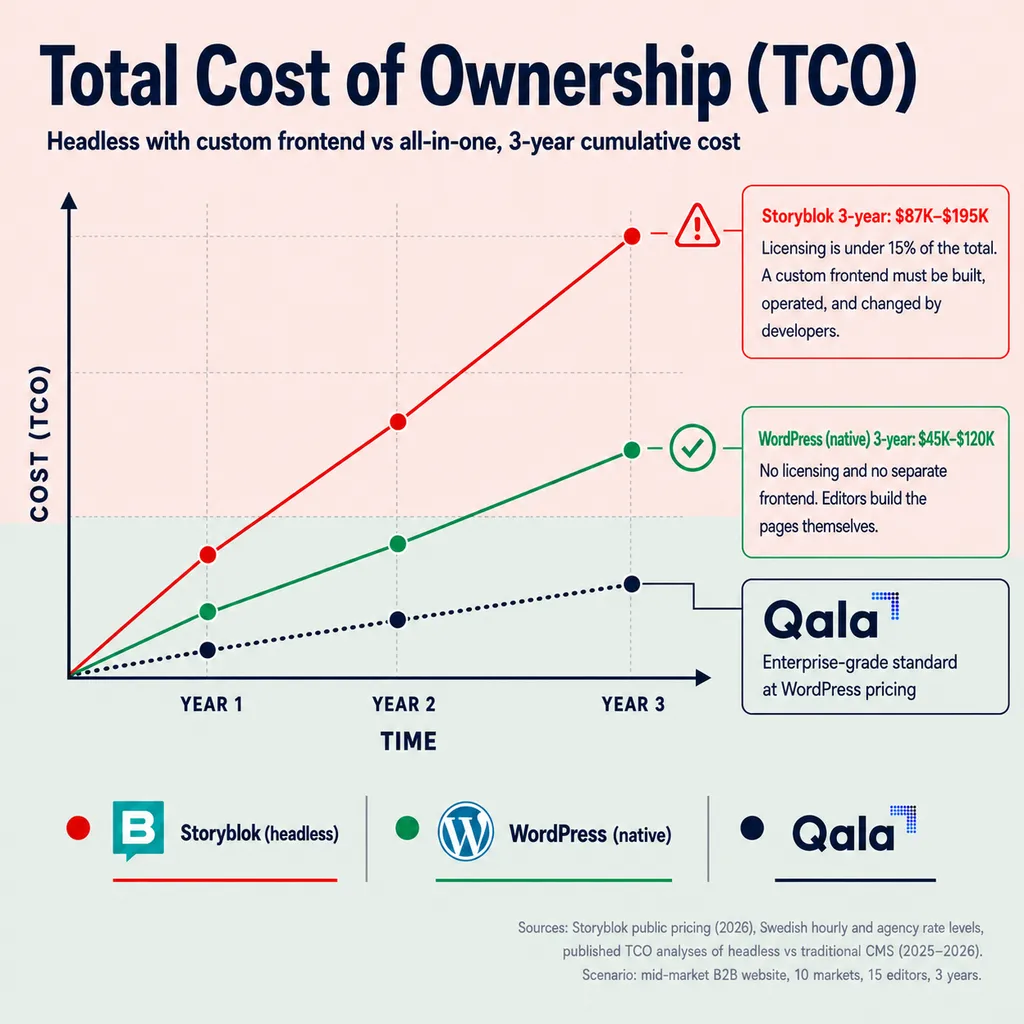
Storyblok’s cost consists of more than just the ongoing SaaS fee.
Since Storyblok does not have its own presentation layer, the organization needs to develop and manage a separate front-end application. This requires its own codebase, hosting environment, deployment process, monitoring, and dependency management.
This isn’t necessarily a problem. In organizations that already work with multiple digital products and have a dedicated front-end team, the separate application can be a natural part of the tech stack.
But for an organization whose primary need is a website or e-commerce platform, this architecture means that a significant number of development hours must be invested before the first business-specific feature is in place.
Components need to be modeled in the CMS and then implemented in the front end. The preview needs to be connected to the external application. SEO logic, navigation, forms, search, sitemaps, and other basic features need to be handled in the presentation layer.
When content models or component contracts change, updates may need to be coordinated between Storyblok and the front-end application. New integrations can also affect the content layer, the presentation layer, and external systems.
The long-term cost, therefore, isn’t just about the license fee. It’s about how much technical capacity is required to manage the overall architecture over time.
WordPress
WordPress can be used in a headless configuration in the same basic way as Storyblok. Content can be modeled using, for example, ACF or custom blocks and exposed via the WordPress REST API to a separate frontend.
If WordPress is built this way, many of the same costs arise as in a Storyblok project. The organization still needs to build, deploy, and manage a separate presentation layer.
This shows that the cost issue isn’t primarily about which CMS is used. It’s about the architectural choice.
WordPress’s major financial advantage is that the separate front end is optional.
By using WordPress’s integrated presentation layer, the organization gains a functional foundation for rendering, navigation, user management, content, plugins, and editorial workflows all within the same platform.
The WordPress core has no license fee, but that doesn’t mean a professional solution is free. Hosting, development, plugins, monitoring, security, and management all cost money regardless of the platform.
The difference is that the investment doesn’t have to start with recreating a presentation layer that WordPress already has.
Qala
Qala is designed to reduce the amount of repetitive basic development in larger WordPress projects.
We use a proven and quality-assured architecture that already includes solutions for many of the needs that would otherwise have to be built individually in each project. This applies, for example, to component structure, search, performance, accessibility, security, and various integration patterns.
This means the project can begin by focusing more closely on the actual business challenge.
Instead of first spending a large portion of the budget on building a front-end application, a component integration, and a separate operations pipeline, the work can focus on design, user experience, conversion, and customer-specific functionality.
Qala does not eliminate development costs. Ambitious digital solutions require expertise, quality assurance, and ongoing maintenance.
What Qala does is reduce the portion of development costs that goes toward repeatedly solving the same fundamental problems. This shortens the path to launch and results in a more predictable total cost of ownership.
E-commerce
Storyblok
Storyblok is a CMS and does not have its own e-commerce engine. To build an e-commerce solution, Storyblok must be connected to an external commerce system, such as a standalone SaaS platform or a composable commerce engine.
The separate front-end application must then retrieve content from Storyblok and product, price, inventory, and customer data from the commerce system.
In an advanced composable architecture, this can provide significant technical freedom. Different systems can be chosen for different parts of the solution, and in theory, they can be replaced independently of one another.
But every separation also creates integration points.
Developers need to determine how content and product data should be combined, which system owns different types of information, and how data should be kept in sync. Previews, search, filtering, campaign logic, and checkout need to work across multiple system boundaries.
This becomes particularly clear in content-driven e-commerce. If editors want to include products, prices, or personalized offers in articles and guides, the front end must be able to combine data from Storyblok with data from the commerce system.
It’s possible to build a very good solution this way. The question is whether the business’s needs justify the additional development and maintenance.

WordPress
WooCommerce integrates tightly with WordPress and uses the same administrative environment, user system, and presentation layer.
This means that products, campaigns, editorial content, and checkout flows can be combined within the same platform. An editor can place product lists, buy buttons, and campaign modules in a guide or landing page using blocks.
WordPress and WooCommerce also have a large ecosystem of solutions for payments, shipping, subscriptions, marketing, and integrations.
That doesn’t mean every e-commerce project can be solved with a simple plugin. Complex international commerce, large product catalogs, and advanced B2B operations require a well-thought-out architecture even within WooCommerce.
The advantage is that the organization can start with an integrated foundation and only separate the components where there’s a clear need.
Qala
Qala E-commerce is designed for organizations that need WordPress’s editorial flexibility combined with more advanced e-commerce functionality.
We build on WooCommerce with architecture and components for, among other things, multiple marketplaces, currencies, price lists, advanced product filtering, search, and integrations with external product and business systems.
This makes it possible to combine editorial content and e-commerce without creating a separate content silo.
The marketing team can work with products, campaigns, guides, and landing pages within a cohesive editorial experience. At the same time, product data and business-critical information can be retrieved from, for example, PIM and ERP systems.
Qalas’ strength, therefore, does not lie in requiring that all systems be built on WordPress. Its strength lies in the fact that we only separate the components where such separation creates clear value.
Plugins
Storyblok
Storyblok has an ecosystem of apps, field extensions, and integrations. These can enhance the editor interface, connect the CMS to external services, and streamline certain aspects of content creation.
The difference from a traditional WordPress plugin is that Storyblok’s apps typically do not handle the entire public-facing functionality.
Since the website is rendered in a separate front-end application, developers still need to determine how the integration should be presented and function for the visitor.
For example, a new form tool can be integrated with the content model, but the form’s components, validation, error handling, and visual presentation must be implemented on the front end.
The same is often true for search, analytics, personalization, product data, and other features.
This provides a great deal of control, but it also means that off-the-shelf integrations do not always eliminate the need for front-end development.
WordPress
WordPress’s strength lies in its global community and the tremendous pace of innovation it drives. With over 60,000 plugins, there’s essentially a ready-made solution for every conceivable need, from advanced analytics and marketing automation to CRM integrations.
This allows you to test new hypotheses and roll out new functionality in hours rather than months. The challenge with this vast selection is that quality varies; it takes experience and a clear strategy to choose the right tools that won’t negatively impact your site’s performance or security, but when handled correctly, it gives you an unbeatable competitive advantage in terms of technical agility.
Even for more unique needs, it’s often possible to develop solutions faster and more cost-effectively than on many other platforms, thanks to the open-source code and established development frameworks. This makes the CMS particularly effective for organizations that want to build upon their solution over time without spending resources on costly further development.
Qala
Qala is designed to combine WordPress’s open ecosystem with the control and technical flexibility required for larger projects.
We don’t use a large number of plugins simply because they’re available. Every component and plugin is evaluated based on code quality, security, performance, support, and long-term maintenance. The solutions included in Qala’s core stack are tested together and updated within a controlled environment.
When a project requires more advanced front-end technology, we can simultaneously build decoupled components on top of the integrated WordPress architecture. For example, search and filtering can be built in React and retrieve data from Elasticsearch to create faster and more interactive experiences.
This allows Qala to take advantage of modern front-end technology without having to build the entire website as a headless site. We retain WordPress’s strengths in content, editing, and its ecosystem, and use more specialized technology in areas where it provides tangible value.

SEO
Storyblock
Storyblock can handle the content fields required for SEO, such as page titles, meta descriptions, and other metadata.
However, since the platform does not render the public website, it is the front-end application that is responsible for ensuring the information is actually implemented correctly in the final HTML code.
This applies, among other things, to:
- metadata
- canonical tags
- hreflang
- structured data
- XML sitemaps
- redirect logic
- internal linking
- search engine rendering
- Core Web Vitals
A well-built headless frontend can perform very well from an SEO perspective. However, headless does not automatically mean better performance or better searchability.
The outcome depends on the technical decisions made in the frontend application and how actively it is maintained over time.
For editors, this also means that SEO features need to be designed and integrated into the workflow. If developers haven’t implemented the necessary functionality, it won’t be automatically available in the CMS.
WordPress
WordPress has a built-in presentation layer and an established foundation for URL structures, headings, metadata, taxonomies, and content hierarchy.
Through SEO plugins, editors can manage key settings and receive guidance directly within the editing environment. This makes SEO an integral part of content creation rather than a separate technical project.
WordPress is not automatically search engine optimized simply because the platform is used. A poor theme, faulty plugins, or poor performance can create problems even in WordPress.
The advantage is that a large part of the basic SEO infrastructure is already in place and can be managed within the same platform as the content.

Qala
Qala builds upon WordPress’s SEO foundation with a quality-assured technical architecture.
Performance, caching, image management, accessibility, and technical SEO components are handled as part of the platform, not as separate plugins that need to be reinvented for every project.
Qala can also be configured for international websites with multiple languages, markets, and domains. This creates a clear structure for elements such as hreflang, localized URLs, and market-specific content.
At the same time, editors gain access to established SEO tools directly within WordPress.
This allows both the technical foundation and ongoing editorial SEO work to be managed in a cohesive environment.
Security
Storyblok
Storyblok is a SaaS platform where the provider is responsible for security in the CMS core, the database, and the API infrastructure. One advantage of the headless model is that the CMS itself does not need to be directly exposed to the website’s public visitors. This can reduce certain types of attacks on the administrative environment.
At the same time, the separate front-end application introduces an additional codebase and production environment that must be secured. Front-end frameworks, JavaScript packages, integration keys, API calls, and hosting configurations must be monitored and updated. Security responsibility therefore does not disappear; it is distributed across more parts of the architecture.
In an organization with established DevOps and security processes, this can be managed effectively. In smaller development organizations, however, the number of environments and dependencies can increase the operational burden.
WordPress
WordPress security relies on transparency and the collective power of the community. With millions of eyes on the code, vulnerabilities are usually identified long before they can be exploited on a large scale, and security patches are often released within hours. When properly configured with modern security tools such as Wordfence or Cloudflare, and hosted on a specialized platform, WordPress offers a level of security that matches or exceeds that of proprietary systems.
The challenge lies in management; WordPress vulnerabilities arise almost exclusively due to outdated plugins or poor practices on the part of the provider, making the choice of a technical partner business-critical.

Qala
Qala is the answer to the security challenge. Instead of a collection of separate tools, the platform is delivered as a guaranteed, fully functional whole, where all components are tested to work optimally together. This provides fundamental security and predictability in both implementation and day-to-day operations.
B2B
Storyblok
Storyblok is primarily a content management system. The platform offers features for editorial workflows, roles, and permissions, but does not include the customer-facing business logic required in many B2B solutions.
Customer-specific price lists, reseller portals, quote workflows, credit rules, restricted-access content, and advanced ordering processes must be handled by external systems or custom-built applications.
The front end must then combine content from Storyblok with data from, for example, CRM, ERP, PIM, identity platforms, and commerce systems.
This may be the right model for organizations that already have a composable architecture and clear system owners for each area.
For other organizations, this means that even relatively standard B2B functions become cross-platform integration projects.

WordPress
WordPress works well as a foundation for B2B websites where content, lead generation, and digital sales need to work together. The platform can be integrated with CRM and marketing automation systems while allowing the marketing team to retain control over content, landing pages, and campaigns.
Through WordPress’s user system and plugin ecosystem, it’s also possible to build logged-in sections, document archives, membership features, and various permission levels.For more advanced B2B commerce, WooCommerce can be combined with customer-specific pricing, quote management, order rules, and integrations with external business systems.
Qala
Qala takes WordPress’s B2B strengths and shapes them into a cohesive ecosystem that works right out of the box. Features for logged-in content, lead capture, and connections to CRM systems aren’t separate plugins, but fully integrated components. This creates a stable and predictable foundation for sales and marketing across multiple regions, and simplifies collaboration between marketing and IT.
International Stores
Storyblok
Storyblok offers language translation features at the component level in its interface, but international scalability requires a massive technical infrastructure in the presentation layer. Managing global expansion with market-specific currencies, local payment methods, and varying VAT rules cannot be handled within the CMS system.
Instead, this business logic must be programmed manually in your front-end application or managed through complex integrations with external e-commerce engines, which increases technical complexity and makes it harder for local marketing teams to operate independently.
WordPress
WordPress handles international growth through a combination of multisite functionality and language plugins such as WPML or MultilingualPress. This makes it possible to manage multiple languages, currencies, and domains within a single structure, which facilitates a presence in multiple markets without sacrificing control or performance.
WooCommerce offers a solid foundation for international commerce, but managing regional pricing, local payment methods, and specific fulfillment centers often requires a well-thought-out architecture and additional plugins. WordPress is an excellent choice for companies that want to expand gradually and maintain control over costs in each individual market.

Qala
Qala is designed from the ground up to handle global e-commerce, with built-in support for local languages, market-specific pricing, tax rules, and country-specific storefronts. Where WooCommerce requires additional configuration, Qala offers a ready-to-use structure that can be managed through a single interface. This makes it easier to expand into new markets while maintaining control over both performance and editorial content.
For companies with large product catalogs across multiple countries, there is a ready-made integration with Pimcore. It ensures consistent product data and efficient delivery across all markets, without creating new silos in the system environment.
When are Storyblok and headless the right choice?
Headless isn’t wrong in itself. It’s an architectural choice that needs to be justified by the business’s actual needs.
Storyblok can be a strong alternative when the same content needs to be distributed to multiple standalone channels, such as websites, apps, digital displays, and other products with completely different interfaces.
It can also be relevant when the website is, in practice, an advanced web application; when the frontend and backend need to be developed independently of each other; or when the organization already has a dedicated team that manages frontend applications and API-based integrations.
In such projects, the added flexibility can create clear business value.
For many marketing websites, B2B portals, and e-commerce solutions, the calculation looks different.
If the public website is the primary channel and editors need to be able to work quickly with content, campaigns, and landing pages, the value of the separate front end must be weighed against the cost of building and managing it.
This is where Qala’s approach differs from a “headless-first” model.
We don’t start by asking how the front end and back end can be separated. We start by asking which architecture provides the business with the most value per krona invested in development.
When a separate presentation layer creates clear value, WordPress can also be used headless. When it doesn’t, there’s rarely any reason to pay for the extra complexity.
Storyblok vs. WordPress vs. Qala: Summary
The choice between Storyblok, WordPress, and Qala isn’t about one platform being modern and another being outdated. Both Storyblok and WordPress can handle structured content and make it available via APIs. Both can be used as the foundation for a headless architecture.
The real difference lies in what the organization needs to build and manage around the CMS.
Storyblok is built for a decoupled model. The platform manages the content, while a separate front-end application handles the presentation. This provides great technical freedom, but it also means the organization needs to develop and manage the presentation layer that makes the content usable for visitors. For organizations that publish to multiple channels, build advanced applications, or already have a dedicated front-end team, this can be a justified investment. For many web and e-commerce projects, however, this same architecture means that a large portion of the budget goes toward a technical separation that does not create corresponding value for editors, visitors, or the business.
WordPress offers a more flexible approach. The platform can be used in a headless configuration when a specific use case requires it, but it also features an integrated presentation layer, a visual editor, and a large ecosystem of ready-made solutions. This allows the organization to choose a simpler architecture without sacrificing the ability to integrate with external systems or build advanced functionality.
Qala is our method for making the integrated WordPress model suitable for larger and more complex projects. Through a quality-assured architecture, pre-built components, and proven integration patterns, we can reduce the amount of repetitive foundational development and devote more of the project’s time to customer experience, conversion, and business-specific features. Qala is therefore not a compromise for organizations that cannot afford a headless approach. It is a deliberate architectural choice for organizations that want to allocate their development budget where it has the greatest impact.
The question isn’t whether you can build a separate presentation layer.
The question is whether that layer creates enough business value to justify its development, operation, and long-term maintenance.
For organizations that want a fast, secure, and scalable web platform with a high degree of editorial freedom, Qala often provides a shorter and more cost-effective path from idea to business value.
Thinking about switching from Storyblok?
Has the headless architecture that was supposed to give you greater flexibility instead become a source of developer dependency, long lead times, and unpredictable costs?
Angry Creative can help you compare the cost of continuing to develop and maintain your existing Storyblok solution with a migration to WordPress and Qala.
We’ll review your current content model, front end, integrations, and editorial workflows to identify where complexity adds real value and, more importantly, where it costs you time and money.
Talk to our founder, Jimmy Rosén, for a straightforward assessment of which architecture provides the best foundation for the next step in your digital development.